Daifuku Intralogistics America

Validate your system performance before you start building
Daifuku's simulation team collaborates with design, controls, and software engineering to create accurate representations of your system within Sym3 Integrator, using discrete event-driven modeling to validate performance and mitigate risk before a single piece of equipment ships.
Build a better system with confident design decisions backed by your data
Daifuku uses discrete event-driven simulation, a series of queued events that trigger behaviors across the system, to gather relevant performance metrics and provide primary support for risk mitigation. Our simulation team collaborates with design, controls, and software engineering to create accurate representations of your system within Sym3 Integrator, modeling both stochastic (randomized distribution) and deterministic (pre-planned scripted) scenarios so your team can make informed decisions before physical commitments are made.


Risk Mitigation
Simulation is primarily used to mitigate risk through design validation and a better understanding of a conceived system. Surface concerns and validate assumptions before engineering resources are committed.

Performance Metrics
Gather system performance metrics across stochastic and deterministic scenarios. Understand throughput, bottlenecks, and behavioral responses to operational stressors before go-live.

Expert Resources
Daifuku's simulation engineers collaborate with design, controls, and software teams to ensure the model reflects real-world system behavior, guiding you from data gathering through final findings and interpretation.
Four simulation stages to keep up with evolving project demands
Trusted by the most innovative facilities in North America for seamless, intelligent adaptation in rapidly changing warehouse, distribution center, and production environments.
01
Visualization
A rendering of the system with limited functionality, primarily used to demonstrate the proposed system layout and material flow to stakeholders before detailed modeling begins.
02
Facile
Intended to test individual and critical subsystems through quick simulations and experiments. Uses standardized and detailed logic for equipment configurations to rapidly validate targeted design elements.
03
Rate
Tests overall material flow with special attention to equipment and labor capabilities. Uses modeled order and flow information to validate core controls concepts and generate throughput statistics via experimental input parameters.
04
Detail
Uses production order data with set and randomized patterns, approximated WCS logic to process real orders, and tracks several metric categories including order release, pick walks, ASRS storage algorithms, inventory controls, and precise equipment control.
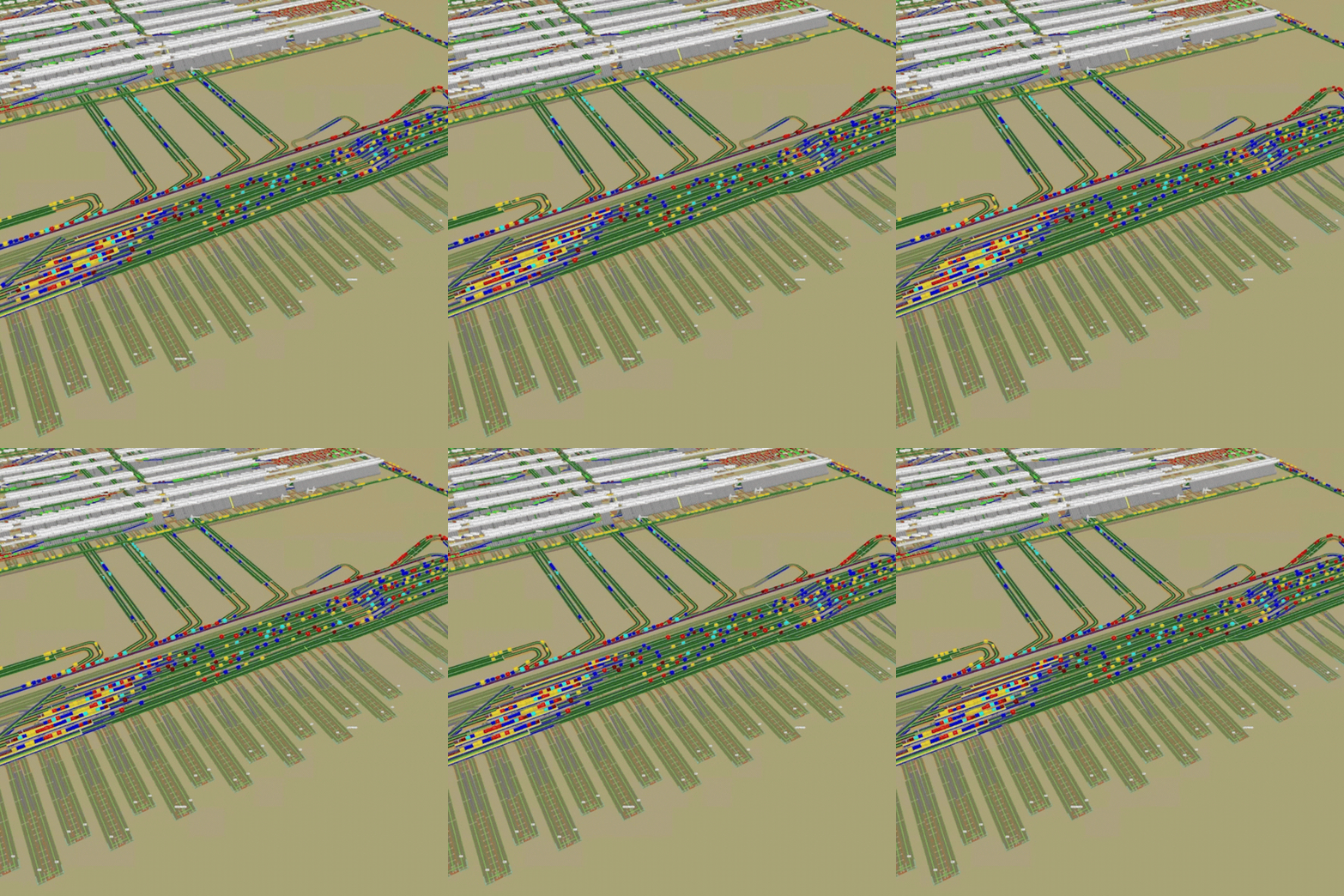
A proven six-stage simulation process that scales with your project.
Every engagement follows a structured methodology: identifying the need and purpose, gathering data and system parameters, establishing assumptions and focal points, building the model in Sym3 Integrator, running experiments with varying inputs, and interpreting findings. Each stage is designed to generate results you can act on.
Stages can be scoped independently or run end-to-end in alignment with your timeline and areas of concern. Whether you need a focused subsystem study or a full detail-level simulation with production order data, the process scales to fit.
Stages can be scoped independently or run end-to-end in alignment with your timeline and areas of concern. Whether you need a focused subsystem study or a full detail-level simulation with production order data, the process scales to fit.
A partner from analysis through launch and beyond.
From initial specifications through onsite volume testing, Daifuku Intralogistics America's process-driven simulation team works alongside you at every phase, delivering clear, actionable findings so you can go live with a more confident, lower-risk system.

Trusted by top organizations around the globe.


Nike Japan
To centralize logistic needs, Nike Japan needed to consolidate three locations.

Coca Cola
For quicker response to changing markets, Coca-Cola sought end-to-end automation.

Skechers
Skechers needed to unify distribution from five separate facility into a single facility.
Contact Us
Connect with our sales team.
Our team is ready to help you increase throughput, improve efficiency, and conserve resources. Send us a message to get started on a material handling solution.
Oops! Something went wrong while submitting the form.


